.png)

How to Exhibit at Defence Trade Shows: A Guide to DSEI, Eurosatory and Getting It Right

Updated: Jul 30

Introduction: Why defence trade shows demand a different approach
Knowing how to exhibit at defence trade shows is not something that transfers from other industries. The audience is different, the environment is different, and the commercial stakes attached to getting your presence right are considerably higher than at most other industry events.
World military expenditure reached $2,718 billion in 2024, an increase of 9.4 per cent in real terms from 2023 and the steepest year-on-year rise since at least the end of the Cold War. Source: SIPRI. That sustained growth in defence budgets is driving increased activity at the world's leading defence trade shows, making them more competitive and more commercially significant than ever. For US brands with European programme ambitions in particular, events like DSEI and Eurosatory have become essential rather than optional.
Defence trade shows are where long-term procurement relationships are built, where technology capabilities are evaluated by some of the most technically informed buyers in any sector, and where a brand's physical presence is read as a direct proxy for the quality and reliability of what it delivers. A stand that underperforms at DSEI or Eurosatory, where reputation is everything and buying cycles stretch over years, can set a brand back in ways that are difficult to recover from quickly.
"Defence events are unlike any other trade show environment," says Sam Allen, Managing Director of Noisy&Co. "The people walking your stand are evaluating. Every detail of how you show up at a defence event, from the quality of the build to the way your team manages access, sends a signal about the organisation behind it."
This guide covers what brands need to know about exhibiting at the world's leading defence trade shows, including what makes the sector unique, the practical and regulatory considerations that apply, and how to design a stand that performs in front of the most demanding audience in the exhibition calendar.
Understanding the defence trade show landscape
The global defence calendar extends well beyond the two headline events. DSEI at ExCeL London attracts delegations from over 100 nations and is effectively non-negotiable for brands with UK and international defence programme ambitions. Eurosatory 2024 drew 2,028 exhibitors from 61 countries, alongside 355 official delegations from 93 countries, making it the broadest international gathering in the land and air defence calendar. Source: EUROSATORY.
Beyond those two, the calendar includes DINE for naval defence, Milipol for homeland security, AUSA in Washington DC for the US Army community, and Modern Day Marine for the US Marine Corps. Each show serves a different segment of the defence community. Understanding those distinctions before committing to a calendar is the first step towards building a programme that generates real commercial return.
DSEI 2025 was the largest in the show's history, comprising approximately 1,700 exhibitors from 62 countries. At DSEI 2023, over 3,250 VIPs and delegations from close to 100 nations attended the event. In that environment, the quality of your physical presence is being evaluated by some of the most senior procurement decision makers in any industry. Source: Wikipedia & DSEI.

The rules that matter at defence events
Defence trade shows operate under a layer of regulatory and security complexity that simply does not exist at other industry events, and the brands that get caught out are almost always the ones that treated it as an afterthought.
The most significant area is technology restrictions. Certain categories of defence equipment, components, and software are subject to export control regulations that determine whether they can be physically present at an international show, demonstrated to foreign nationals, or even discussed in a public environment. In the UK this falls under the Export Control Joint Unit framework. In the US, ITAR governs what American defence technology can be shown and to whom, and the rules apply regardless of which country the show is taking place in. For US brands exhibiting at DSEI or Eurosatory, ITAR compliance needs to be built into the exhibition planning process from the outset, with legal sign-off on what can be shown, to whom, and under what conditions.
Access control on the stand is the physical expression of that compliance. Restricted demonstration areas, controlled entry points, and the ability to verify the credentials of visitors before they enter certain zones are all standard requirements for many defence exhibitors. The challenge is integrating those requirements into a stand design that still feels intentional and brand-led rather than defensive and unwelcoming. A well-designed defence stand manages access invisibly, using architecture and spatial planning to control who sees what without making visitors feel they are being processed through a security checkpoint.
Photography and filming restrictions are another consideration that catches exhibitors off guard. Many defence brands prohibit photography of specific products or technology on their stand, but enforcing that policy in a busy show environment requires advance planning around signage, staff briefing, and the physical layout of the stand.
"The regulatory side of defence exhibiting is where we see brands come unstuck most often," says James Hunt, Events and Technical Director at Noisy&Co. "Not because they are not aware of the rules, but because they leave the practical implications too late. By the time you are designing the stand, the compliance framework should already be in place."
Designing a defence exhibition stand that works
The design brief for a defence exhibition stand is almost always pulling in two directions simultaneously. On one side, the need to project a bold, authoritative brand presence that is visible and compelling across a busy show floor. On the other, the need for controlled, private environments where sensitive technology demonstrations and high-level stakeholder meetings can take place without compromise.
Getting that balance right is the central creative challenge of exhibiting in the defence sector, and it is one that needs to be resolved at the design stage rather than managed operationally on site.
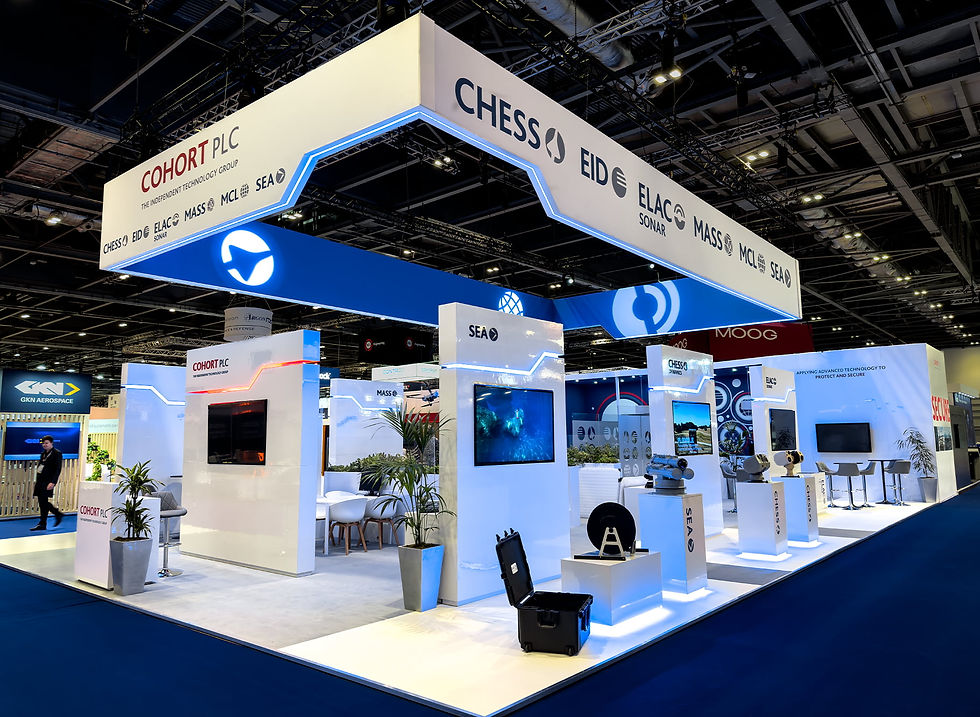
The most effective defence stands are built around what we call the impact versus intimacy principle. An outward-facing environment that draws delegates in and communicates capability and brand authority clearly and immediately. And an inner environment, architecturally separate but visually coherent, where the conversations that actually move procurement relationships forward can happen properly.
Material quality and build precision matter more in the defence sector than almost anywhere else. The audience evaluating your stand includes procurement professionals whose entire working brief is assessing quality, reliability, and attention to detail. A stand with visible snagging, poor finishing, or technology that does not work reliably on day one sends a signal that no amount of marketing material can correct.
This is where the Final 5% Rule becomes particularly relevant. The final 5% of a stand build, the snagging, the finishing details, the technology testing, the handover checks, is where the difference between a good stand and an exceptional one is made. In defence, that difference is noticed by exactly the audience you most need to impress. You can read more about our approach to defence exhibition stand design and what that means in practice.
Planning and budgeting for defence trade shows
The two year cycle of DSEI and Eurosatory creates a planning dynamic that catches brands out more often than it should. The next edition always feels distant until it suddenly is not, and the consequences of a compressed timeline in the defence sector are more severe than at most other shows.
For smaller stands, six months is a workable lead time and we have delivered defence exhibition stands with as little as two months notice where the brief allows. For larger or more complex stands, twelve months or more is the appropriate starting point. That lead time is not primarily about the build. It is about the strategy, the compliance framework, the access control planning, and the technology decisions that all need to be resolved before a design brief can be properly written.
Budgeting for defence events carries its own set of considerations that brands consistently underestimate. The cost of building a compliant restricted demonstration environment, integrating access control technology, and meeting the specific material and finish standards that a defence audience expects all add to a baseline budget that is already higher than most other sectors. Logistics costs for defence events are also significant, particularly for brands shipping specialist equipment across borders, where export documentation, customs clearance, and specialist freight handling all need to be factored in from the outset.
The most expensive mistake in defence exhibiting is underspending on the elements that matter most and then attempting to compensate with volume. A smaller, precisely executed stand built around a clear strategic objective will consistently outperform a larger stand that has spread its budget too thinly across too many competing priorities.
Advice for international brands exhibiting at European defence shows
For US and non-European defence brands, DSEI and Eurosatory represent two of the most important opportunities on the global calendar to engage with European procurement communities. But the practical and regulatory challenges are worth understanding before committing to either show.
ITAR is the starting point for most US brands. The rules governing what American defence technology can be shown, and to whom, apply regardless of which country the show is in. Legal sign-off on what can be demonstrated needs to be secured well before the design process begins.
Logistics into the UK and France each carry their own complexity. Since Brexit, shipping into the UK for DSEI involves customs requirements that did not previously apply to European exhibitors. Eurosatory adds French import regulations for certain categories of defence technology that require early planning with a freight partner who knows the show.
There is also a cultural dimension that international brands sometimes underestimate. The procurement culture at DSEI is shaped by the Anglo-American defence relationship. Eurosatory is more diplomatically diverse, with delegations from over 60 nations each bringing their own expectations. A stand built purely around a US domestic communication style will not land in the same way in either environment.
Working with a UK headquartered exhibition partner who understands both shows removes a significant layer of risk from the process.
Where to start
Exhibiting at defence trade shows rewards brands that approach them with the same rigour they apply to everything else they do in the sector. The planning starts earlier than most expect, the compliance considerations run deeper than most anticipate, and the standard of execution required to make the right impression on the right audience is higher than at almost any other trade show environment.
The brands that consistently perform at DSEI and Eurosatory are the ones that treat every edition as a strategic opportunity, plan accordingly, and work with partners who understand the specific demands of the sector.
If you are planning your next defence trade show presence, start with a clear brief, a realistic budget, and a partner who has delivered in this environment before.
Noisy&Co specialises in defence exhibition stands for brands exhibiting at the world's leading defence events. Find out more about our approach to DSEI and Eurosatory, or get in touch to discuss your next project.
Author
Sam Allen
Founder
Sam has 19 years of experience in marketing and agency leadership, having founded two agencies and sold one to a Berkshire Hathaway company. He has worked across events and digital marketing, publishing numerous thought leadership articles on platforms such as www.exhibitionnews.uk and www.eventindustrynews.com.