.png)

Global Quality Control For Exhibition Booths

Updated: Jul 30

Many global tours fall victim to a quality gap, the noticeable drop in finish and durability when a stand is delivered by different builders across varying continents.
The reality is that local builders naturally follow local standards. Without rigorous oversight, your brand identity can quickly become diluted, appearing as a budget version of itself depending on the territory. At Noisy&Co, we believe your standards must remain universal. Managing global quality control is about focusing on the final 5%, the meticulous snagging and material precision that separates a functional exhibition booth from a world-class brand experience.
1. Strategic Sourcing: The Three Delivery Models
When expanding internationally, brands must select a model that effectively safeguards their quality standards. Each brand needs to balance the significance of consistency with logistical costs and the time required to manage the process internally.
Model A: Single-Source & Global Shipping
For brands with highly complex, bespoke exhibition designs or specific proprietary finishes, using one trusted supplier to fabricate and ship the entire exhibition booth to every destination is the gold standard for quality.
The Advantage: Total consistency. Since the same craftsmen build the stand for every show, you eliminate regional variations in materials and paint finishes.
The Trade-off: This is the most logistically intensive option, involving higher freight costs, potential customs delays, and a larger carbon footprint.
Model B: Lead Agency
At Noisy&Co, we typically operate this hybrid model. We act as a central brand guardian, using our vetted network of international partners to build locally while we maintain oversight of the standards.
The Advantage: You get the best of both worlds, local expertise and lower shipping costs, but with a single point of accountability to ensure the standard is met worldwide.
The Trade-off: Requires a lead agency fee, but this is usually offset by the savings found in local labour and reduced shipping.
Model C: Local Direct Sourcing
This involves the exhibitor finding and managing a different local contractor in every city or region.
The Advantage: This is often the most cost-effective on-paper solution, as it removes agency fees and shipping costs entirely.
The Trade-off: This model requires significant internal management time. Without a central lead, you are responsible for checking every technical drawing, verifying every material, and bridging the communication gap between different construction cultures. Quality can fluctuate wildly from one show to the next.
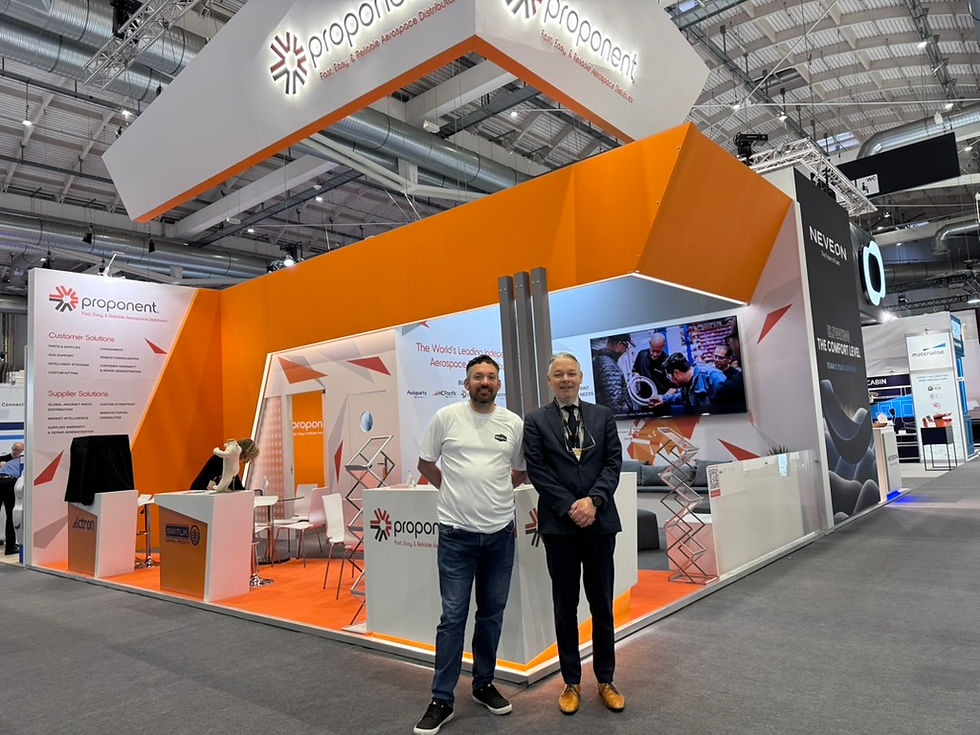
Consistency Across Continents: Proponent at MRO Americas and AIX
Proponent needed two stands delivered days apart, MRO Americas in Atlanta, then Aircraft Interiors Expo in Hamburg, with no shared build team and no room for the Hamburg stand to read as a lesser version of the Atlanta one.
"Different builders, different countries, same brand. That's the actual test of a quality control process, not whether it works once, but whether it works twice in a week under pressure." - Sam Allen, Managing Director, Noisy&Co
Both stands were delivered to the same standard, sustaining a continued client partnership across both aerospace shows.
2. Material Specification
Materials vary significantly by territory based on local supply chains, fire regulations, and traditional construction methods. To maintain quality, you must move beyond visual renders and specify the exact technical requirements of your stand.
The Substrate Problem
In many regions, particularly where labour is cheap but materials are expensive, builders may use thinner substrates to save costs.
The Quality Risk: Using 12mm MDF or thin plywood instead of the European-standard 18mm can result in walls that flex, seams that pop under tension, and an overall flimsy feel.
The Fix: Explicitly specify substrate thickness in your technical drawings for every region.
Finishes: White isn't just White
Different countries use different paint bases and application methods.
Paint vs. Laminate: In some markets, a painted finish might mean a single coat of matte emulsion that marks easily. In others, it might be a high-gloss spray.
The Fix: Whenever possible, specify RAL or Pantone codes rather than descriptive names. For high-traffic areas, we often recommend moving away from paint entirely in favour of laminates or high-quality vinyl wraps, which provide a consistent, wipe-clean finish regardless of the local climate.
Navigating Regional Regulations
Materials that are legal in one country may be prohibited in another due to strict fire-retardancy or environmental laws.
Fire Ratings: Europe (B1/M1), the UK (Class 0), and the US (NFPA 701) all have different certification requirements for fabrics and timbers.
The Fix: Ensure your materials are dual-certified or that your local partner provides local certification fire-test certificates well in advance of the build.
Electrical and Lighting Temperatures
Lighting plays a crucial role in shaping a brand's visual identity.
The Kelvin Variance: In some regions, Cool White (high Kelvin) lighting is the default, which can make your brand look clinical or blue. In others, Warm White is standard, potentially making your graphics look yellow.
The Fix: Specify the exact Kelvin (K) temperature for all LED strips and spotlights (typically 4000K for a neutral, daylight look) to ensure your brand colours are rendered accurately in every hall.
3. Digital and Graphic Integrity
Graphics and AV are the most visible elements of your exhibition stand. To maintain quality across different territories, you must move beyond sending a PDF and start specifying the technical output.
The CMYK and Colour Standard
Large-format printing is not a universal science, and brand red can easily shift toward orange or purple depending on local printer calibration.
The Fix: Ensure all artwork is strictly prepared in CMYK with embedded colour profiles.
The Graphic Specification Pack
Provide a clear specification for every graphic asset:
Substrate & Finish: Specify the exact material (e.g., 5mm Foamex or 210gsm Tension Fabric) and the finish. For high-traffic areas, an anti-scuff laminate is essential to prevent the exhibition stand from looking tired by day two of the show.
Resolution: Mandate a minimum of 150dpi at 1:1 scale to prevent pixelation on large-scale walls.
AV: The Clean Tech Look
Nothing ruins a premium brand experience faster than visible spaghetti cabling.
Integrated Cable Management: We specify dedicated internal channels and ventilated server closets within the exhibition stand design.
4. The Verification and Snagging Process
The most critical window for quality control is the period immediately before the stand arrives at the venue and the final hours on the show floor.
The Progress Sign-off Stage
Ideally, a full workshop pre-build allows for a dry run of the entire stand. However, when working across multiple continents, this isn't always possible due to tight timelines or local facility constraints.
The Solution: If a full pre-build isn't achievable, the local builder must provide high-resolution photos and videos of the key components and finishes as they are being constructed.
What to look for: Close-up shots of paint finishes, graphic test prints, and structural joins.
The Role of the On-site Project Manager
Even with a trusted partner, the final 5% of the build is where the quality often fluctuates. This is the snagging phase, ensuring edges are clean, seams are invisible, and the floor is perfectly level.
Brand Guardian: The PM's role is to bridge the gap between local standards and your brand standards. They act as the final filter, ensuring that the local crew doesn't leave the site until every surface is pristine.
The Final 24-Hour Audit
Ensure a rigorous QC process to ensure the stand is retail-ready:
Structural Seams: Are wall joins seamless or covered with professional trim?
Graphic Application: Are there any bubbles, creases, or misalignments in the vinyl or fabric?
Functionality: Do all doors, cupboards, and interactive elements operate smoothly?
Tech Check: Is every screen calibrated to the same brightness and colour temperature?
The Final 5%: Kobelco's 4,675 sqm Build
Scale is where quality control gets tested hardest. Kobelco's construction exhibition space at Bauma in Germany ran to 4,675 sqm across two levels, with 600 tons of display equipment placed on site, a 150-cover restaurant, two fully equipped kitchens, an outside bar, and two shops, all needing to meet the same finish standard regardless of which structure a visitor happened to be standing in.
4,675 sqm across two levels, 600 tons of display equipment verified on-site, Zero brand inconsistencies across structures at handover "At that scale, quality control is dozens of smaller sign-offs happening in parallel, all against the same checklist." - James Hunt, Events & Technical Director, Noisy&Co
Every vehicle and piece of display equipment on site was sold by the end of the event, alongside record merchandise and bar sales, a result that depends on visitors trusting the environment enough to buy into it.
Conclusion: Protecting the Investment
Global quality control is ultimately an insurance policy on your exhibition spend. Specifying the right materials, enforcing CMYK standards, and having a brand guardian on-site for the final snagging ensures that your brand looks as impressive in Sydney as it does in London.
How Noisy&Co can help
We specialise in the financial and logistical delivery of exhibition stands worldwide. Whether you are planning a single US debut or a complex multi-city tour in 2026, we provide the regional expertise to ensure your budget is managed with total transparency.
Contact hello@noisyandco.com to discuss your upcoming international events.
Author
Sam Allen
Founder
Sam has 19 years of experience in marketing and agency leadership, having founded two agencies and sold one to a Berkshire Hathaway company. He has worked across events and digital marketing, publishing numerous thought leadership articles on platforms such as Exhibition News and Event Industry News.